|
Happy Monday! In a no-holds-barred discussion, Corey Quinn, chief cloud economist at The Duckbill Group and popular AWS commentator, will cut through the hype and deliver incisive insights on the realities of securing your data in the cloud. Join Rubrik’s webinar tomorrow, December 17, for the latest security knowledge.
In today’s edition:
 Go see HR Go see HR
 DIY hard DIY hard
 Chip it real good Chip it real good
—Brianna Monsanto, Billy Hurley, Patrick Lucas Austin
|
|
|
IT OPERATIONS
|
From afar, there’s nothing out of the ordinary about Workleap’s IT department, which supports roughly 450 employees each day. However, some may raise eyebrows upon learning that the team of roughly eight employees doesn’t report to an IT manager, but is instead supervised by another unsung hero department: HR.
Since August, Workleap’s IT team has reported to Cyril Boisard, Workleap’s director of people, a move he told IT Brew has been in the works for a long time and one that he made after seeing many “parallels” between HR and IT in how they support the “experience of the user.”
“It was making a lot of sense to add it to the HR because [in] HR, we define policy,” Boisard said. “We talk with users and [our] primary focus is the experience of the employee. But that’s also what we want to be the focus of IT.”
The process. Boisard told IT Brew the first steps of the transition involved him learning what was going on in Workleap’s IT department, including ongoing projects and the overall vision Martin Sirard, Workleap’s IT support manager, had for the team moving forward.
Read the rest here.—BM
|
|
|
|
|
|
Presented By Akamai
|
And in the day, evening, and weekend. Basically, APIs are bad news, and they’re not taking any days off.
Akamai’s 2024 API Security Impact Study surveyed 1,200+ security leaders to get their take on APIs. They demonstrated eye-opening consensus on:
- seeing API security incidents rise for three years and counting
- spending more than half a mil recovering from said incidents

- feeling the human toll and reputational damage
While APIs are clearly a growing attack vector, respondents offered mixed reviews on the completeness of their API inventories. Turns out the traditional tools they’re relying on to protect APIs don’t fully cover the risk.
Need solutions, strategies, and advice from like-minded pros? Kick APIs out of the driver’s seat with Akamai’s 2024 API Security Impact Study.
|
|
|
CYBERSECURITY
|
Like that one kid in every group project in high school, malicious hackers are tricking you into doing a lot of the hard work.
Cybersecurity company Gen examined its Q3 threat data and saw a 614% quarterly increase in “scam-yourself” attacks: fake tutorials, updates, CAPTCHAs, and fixes that trick users into deploying step-by-step malware installation. Several researchers and vendors have noticed the social engineering trend this year.
“For security solutions, it might be harder to identify that this is a malicious action, as we’re seeing it’s the user doing it,” Luis Corrons, security evangelist at Gen, told IT Brew.
In its report, Gen observed deceptive examples:
-
YouTube tutorials: A video, cited by Gen, walks the user through a software installation, but a download link, found in the comments, leads to malware.
-
README files: The cybersecurity company shared screenshots of instructions that lead to malicious actions, like disabling antivirus software.
-
ClickFixes: Gen observed alert windows that convince users to remediate a problem by copying a script to a clipboard, pasting it to the command prompt, and hitting “enter.”
It’s not just Gen. IT Brew has also reported on fake CAPTCHAs that weaponize copy-and-paste and trick humans-just-trying-to-prove-they’re-humans into running malicious commands. (In Q3 alone, Gen claims it stopped fake CAPTCHA attacks against 2.1 million users.)
Read more here.—BH
|
|
|
|
|
|
HARDWARE
|
Google unveiled a new quantum chip that has racked up some mic-dropping achievements.
The chip, which goes by Willow, was introduced in a research paper published on Nature and a blog post by Google Quantum AI lead and founder Hartmut Neven earlier this week. In the post, Neven touted some of Willow’s accomplishments, including how the chip cracked a “key challenge” in quantum error correction, techniques used to shield quantum information from errors. Willow is capable of reducing errors “exponentially” as the amount of qubits, a basic unit of information in quantum computing, increases (usually, more qubits equals more errors).
If that’s not impressive, Willow also completed a standard benchmark computation in under five minutes. For comparison, today’s fastest supercomputer is able to complete the same computation in 10 septillion years (that’s 10,000,000,000,000,000,000,000,000 years!).
“As the first system below threshold, this is the most convincing prototype for a scalable logical qubit built to date,” Neven wrote in a blog post. “It’s a strong sign that useful, very large quantum computers can indeed be built.”
Keep reading here.—BM
|
|
|
|
|
|
A message from IBM
Work in progress. Hear from Cathy Reese, Public Data and Technology Service Line Leader at IBM Consulting, on how orgs (like yours) can overcome obstacles and make progress with AI in The AI Agenda. This video series from IBM breaks down how you can assess your AI readiness + more. Tune in here. |
|
Level up your career with these resources from our sponsors!
|
|
|
|
PATCH NOTES
Today’s top IT reads.
Stat: 46%. That’s the number of surveyed teens who say they’re online “almost constantly.” (Pew Research Center)
Quote: “30 years was a good run.”—whistleblower-turned-security consultant Chelsea Manning, on the topic of a free, open internet (PCMag)
Read: Why one machine-learning expert believes new AI forecasting models will improve weather predictions. (CNN)
Science insights: The Nautilus newsletter features inspiring stories from some of the greatest minds in science and literature. Get the foremost literary science mag in your inbox when you sign up for free.* *A message from our sponsor.
|
|
|
|
SHARE THE BREW
|
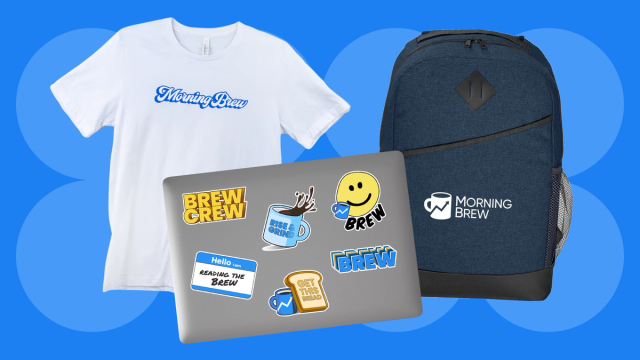
Share IT Brew with your coworkers, acquire free Brew swag, and then make new friends as a result of your fresh Brew swag.
We’re saying we’ll give you free stuff and more friends if you share a link. One link.
Your referral count: 2
Click to Share
Or copy & paste your referral link to others:
itbrew.com/r/?kid=9ec4d467
|
|
|
ADVERTISE
//
CAREERS
//
SHOP
//
FAQ
Update your email preferences or unsubscribe
.
View our privacy policy
.
Copyright ©
2024
Morning Brew. All rights reserved.
22 W 19th St, 4th Floor, New York, NY 10011
|
|