It’s Monday! It’s National Nachos Day, which feels like something made up by Big Guac...but that shouldn’t stop you from enjoying a huge pile at your desk. Just clean up your keyboard afterwards.
In today’s edition:
🛞 Generative motors
 .ai takeover .ai takeover
 Kids protect the darndest things Kids protect the darndest things
—Billy Hurley, Tom McKay, Eoin Higgins, Patrick Lucas Austin
|
|
Hannah Minn
One company not afraid to take generative AI for a test drive: CarMax.
The used-car retailer behemoth has been kicking the tires of the new tech to bolster its value proposition: helping people find cars.
The input and the output. A CarMax search optimization team employed the neural network-based language model GPT-3.5 to aggregate a comprehensive set of reviews for requested makes and models.
The company’s SEO staff tasked GPT with digesting online evals, sent out 30 days after a purchase. The model then presented a paragraph summary—one that’s reviewed by a human writer and then posted on the site.
A request like, “Summarize reviews CarMax customers left for a 2022 Jeep Liberty” led to a long list of individual opinions, ranging from the detailed (“perfect height to step in. Don’t have to step up or bend knees to get in car”), to the straightforward (“I love my Jeep”), to competing ideas about mileage (“awesome” and “great” to some, “not great” to at least one).
Read more here.—BH
Do you work in IT or have information about your IT department you want to share? Email [email protected].
|
|
{if !profile.vars.num || (profile.vars.num >= 0 && profile.vars.num < 60)}
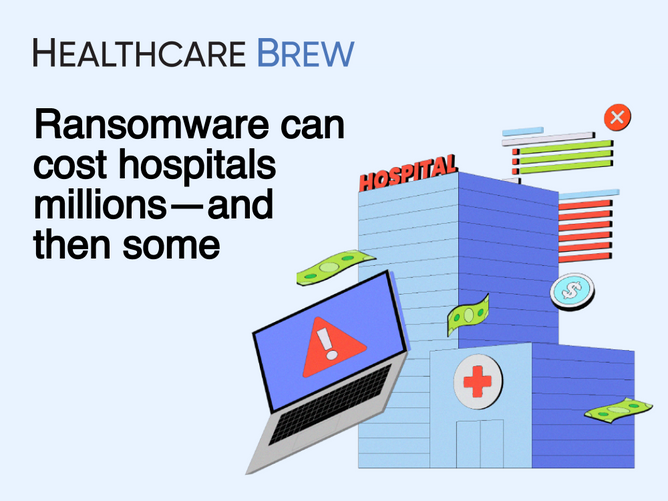
As ransomware attacks become more and more frequent, hospitals and other medical providers are paying a hefty price. Beyond the initial ransom demanded by hackers, costs can arise from remediation, lost patient revenue, and delayed patient care.
The introduction of new laws around how and when ransomware attacks are reported is also changing how health systems can react to such attacks. Healthcare Brew dove into what this means for the industry—read more and listen to the article here.
|
|
{/if}
Andrey Suslov/Getty Images
Forgot to register an organizational .ai domain? Odds are good someone’s already snatched it up.
According to a recent report by compliance services firm CSC, from 2022 to 2023 the number of domain dispute cases over .ai extensions increased by 350% YOY. That indicates a surge in domain squatting by third parties looking to misappropriate other companies’ brands, CSC argued.
Cybersquatters are often little more than rent-seekers hoping to cash in by flipping choice domains for exorbitant prices. While most domains run in the hundreds to thousands of dollars, NameBio data on over 8,000 sales shows a handful of .ai domains have sold for hundreds of thousands (the highest on the list is you.ai at $700,000, while the average price is nearly $1,200).
But URLs that might attract wandering netizens via typos, misdirects, or random chance are also easily utilized for a variety of more malicious purposes like brand impersonation, malware distribution, and phishing. Threat actors often use tactics like SEO poisoning and malvertising to boost the search rankings and traffic of illegitimate sites.
When Google announced new top-level domains matching common file types like .zip and .mov in May 2023, for example, the SANS Institute quickly detected a spike in registrations of websites like “chrome-installer.zip” with no immediately obvious legitimate purpose.
Read more here.—TM
Do you work in IT or have information about your IT department you want to share? Email [email protected]. Want to go encrypted? Ask Tom for his Signal.
|
|
Zgel/Getty Images
The kids are alright—at least when it comes to privacy.
That’s according to findings from Cisco’s 2023 Consumer Privacy Survey of 2,600 adults in 12 countries from Europe, Asia, and the Americas. The report indicated that consumers are increasingly invested in privacy and concerned about the future applications of AI, among other issues.
“If organizations are not transparent about how they use customers’ personal data or how they make data-driven decisions, consumers more willingly take action to protect their data and themselves,” according to the Cisco researchers.
Researchers highlighted points of interest from the survey:
- Consumers, specifically younger consumers, are taking privacy seriously
- Governmental action and privacy laws are seen as positive
- Local data storage may be safer, but not considered worth it
- AI using personal information is a concern
- Companies need to earn trust on AI
- Generative AI risks are well understood by most users, but only one-half are taking action to protect themselves
Privacy active. This is Cisco’s fifth such annual survey, which focuses on the “privacy active” user and the way consumers approach security online. Privacy actives, as defined by the survey, are “people who say they care about privacy, are willing to act to protect it, and most importantly, have already taken action by switching companies or providers over their data policies or data-sharing practice.” And taking that approach is heavily weighted to younger users, with 42% of those 18–24 identified as privacy actives and only 15% of those over 75 meeting that standard.
Keep reading here.—EH
Do you work in IT or have information about your IT department you want to share? Email [email protected].
|
|
{if !profile.vars.num || (profile.vars.num >= 0 && profile.vars.num < 60)}
TOGETHER WITH PLURALSIGHT
|
|
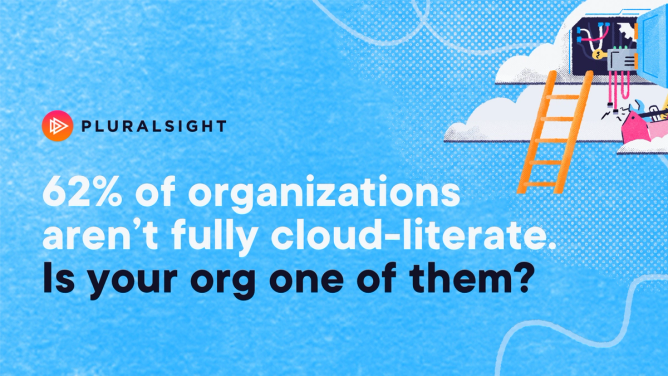
Clear up the cloud(s). There’s a difference between using the cloud and utilizing it to drive real results. Pluralsight’s 2023 State of Cloud report surveyed 1k+ leaders to learn how organizations are taking advantage of cloud-based tech to meet their goals and create clear strategies. Dig into the full report.
|
|
{/if}
{if profile.vars.split == true}
Francis Scialabba
Today’s top IT reads.
Stat: 88 million. That’s the number of Americans who have been impacted by healthcare breaches in 2023. (Department of Health and Human Services)
Quote: “The probability of it going bad is not zero percent.”—Tech billionaire Elon Musk on AI (Insider)
Read: One writer goes to an “alligator party” to see if SEO is ruining the internet. (The Verge)
{if !profile.vars.num || (profile.vars.num >= 0 && profile.vars.num < 60)} B2Blast off: Want more viz for your B2B biz? Getting your message in front of the Brew’s 22m+ engaged monthly readers can foster more clicks, visibility, and conversions. Learn more about our paid advertising. {/if}
|
|
{else}
Francis Scialabba
Today’s top IT reads.
Stat: 88 million. That’s the number of Americans who have been impacted by healthcare breaches in 2023. (Department of Health and Human Services)
Quote: “The probability of it going bad is not zero percent.”—Tech billionaire Elon Musk on AI (Insider)
Read: One writer goes to an “alligator party” to see if SEO is ruining the internet. (The Verge)
{if !profile.vars.num || (profile.vars.num >= 0 && profile.vars.num < 60)} B2Blast off: Want more viz for your B2B biz? Getting your message in front of the Brew’s 22m+ engaged monthly readers can foster more clicks, visibility, and conversions. Learn more about our paid advertising. {/if}
|
|
{/if}
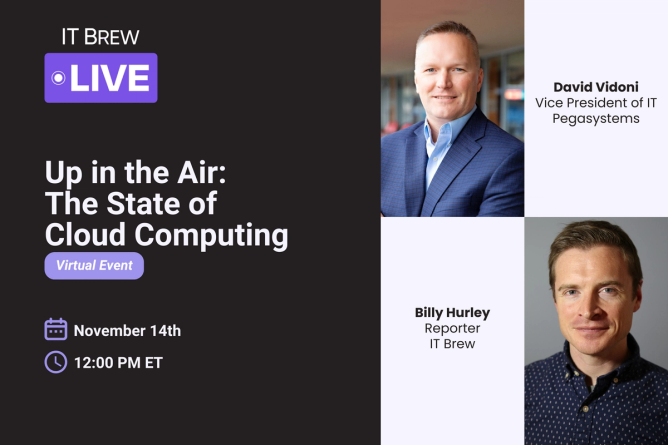
Cloud deployments are no longer a distant future but an integral part of today’s business operations. To stay competitive and reduce costs, it’s essential to address the challenges posed by cloud management in the age of AI. Join us virtually to explore the latest trends and gain a comprehensive understanding of how to mitigate the biggest costs and threats associated with cloud deployments.
Register now.
|
|
|