Friday? Fantastic! If you’ve ever wanted to advocate for the interns in the office, good news—the NLRB recently ruled that employees are allowed to do that.
In today’s edition:
 Fixer-upper Fixer-upper
 You’re hired! You’re hired!
 Snitchin’ wheels Snitchin’ wheels
—Tom McKay, Kelcee Griffis, Eoin Higgins, Patrick Lucas Austin
|
|
Frank Scialabba
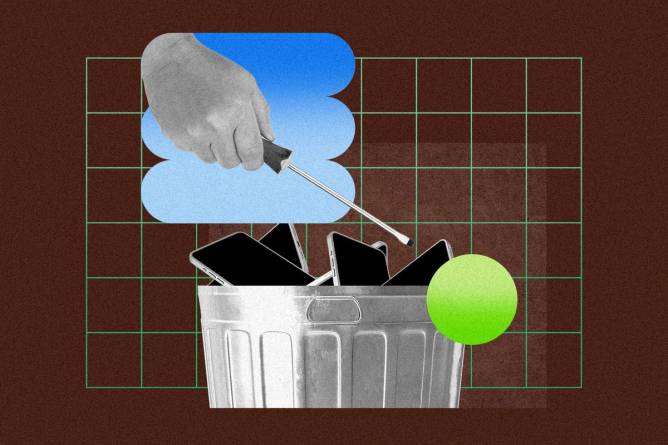
Minnesota recently signed one of the most expansive right-to-repair bills yet, marking a major win for activists.
The new law, signed by Governor Tim Walsh in May, goes into effect July 2024, and covers most categories of electronics. It requires manufacturers to provide third-party repair shops the same parts, tools, and documentation—the last for free—that they use in-house or at official repair providers for all devices manufactured after July 2021. Unlike a law in New York passed earlier this year, it covers electronics sold via business-to-business and business-to-government contracts.
According to the Public Interest Research Group, a nonprofit that backs right-to-repair legislation across the country, Minnesota is the fourth state to do so. While proponents say the law will make it much easier for individual consumers to repair their devices at reasonable prices, the impact for enterprises and other organizations that tend to purchase equipment in bulk and under service contracts is less clear.
Making repairs cheaper. Nathan Proctor, who heads PIRG’s right-to-repair campaigns in the US, says the laws are primarily intended for two purposes: consumer protection and slashing the exorbitant amount of unnecessary e-waste generated when they replace rather than repair products. There is rarely any reason for manufacturers to restrict repairs other than profit from service contracts, Proctor told IT Brew.
Read more here.—TM
Do you work in IT or have information about your IT department you want to share? Email [email protected]. Want to go encrypted? Ask Tom for his Signal.
|
|
Here’s a stat for you: 75% of technologists face more IT complexity than ever before and wrestle with overwhelming data noise. All that data is useless when you’re unable to draw insights and act fast enough to resolve issues.
You have to unify, and Cisco Full-Stack Observability helps you see everything and then do anything. Say hi to the kind of souped-up visibility that drives business transformation and gives you what you need to defend your business systems wherever they live.
When it comes to unifying observability, Cisco’s the real deal. We’re talkin’ consolidated vis across critical IT domains such as infrastructure, network, applications, cybersecurity, digital experience—you name it.
Start a free trial and get better oversight.
|
|
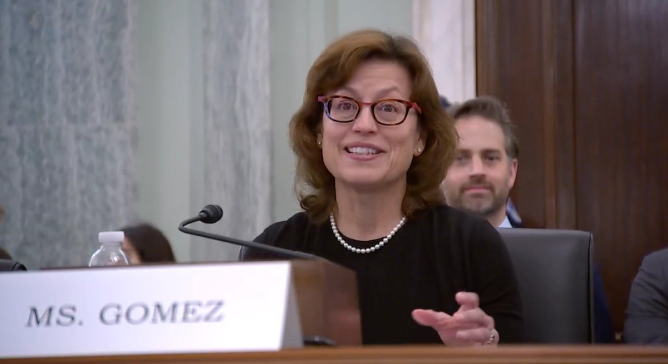
Screenshot of Anna Gomez during the June 22, 2023 Nomination Hearing via Senate Committee on Commerce, Science, and Transportation
After two and a half years, the Federal Communications Commission (FCC) finally has a full bench, which means we may soon see movement on Democratic priorities like cracking down on digital discrimination.
In a 55–43 vote, the Senate approved the Biden administration’s pick of longtime DC telecom attorney and regulator Anna Gomez to fill the fifth and final leadership seat at the agency.
“Anna brings with her a wealth of telecommunications experience, a substantial record of public service, and a history of working to ensure the United States stays on the cutting edge of keeping us all connected,” FCC Chair Jessica Rosenworcel said in a statement. “I look forward to working with her to advance the agency’s mission to ensure the benefits of modern communications reach everyone, everywhere.”
The vacancy at the communications regulator, which is run by three majority party members and two minority members, languished after Senate conservatives took aim at President Biden’s first nomination, prominent Democrat and advocate Gigi Sohn. Sohn ultimately withdrew from consideration after detractors expressed concerns, including that she was too “extreme” to be politically palatable and that she would conflict with cable and broadcast interests based on her association with a now-shuttered streaming startup.
Gomez comes to the FCC most recently from the State Department, where she worked as a senior advisor on international communications policy. She previously spent years at the FCC doing regulatory work, held a VP of government affairs role at Sprint Nextel, and later moved to Wiley Rein as a partner. She’s the first Latina to hold a top leadership position in the agency since Clinton-era Commissioner Gloria Tristani left the post in 2001.
Read more here.—KG
Do you work in IT or have information about your IT department you want to share? Email [email protected].
|
|
Unsplash
You never know what might happen on the open road—your car, for example, might be stealing data related to your sex life.
That’s according to findings from a Mozilla review of safety and privacy standards from a number of automakers that revealed, as the blog post announcing the study put it, that “Cars Are the Worst Product Category We Have Ever Reviewed for Privacy.”
Mozilla ranked 25 carmakers on deficiencies related to data use, data control, track record, security, and AI, and found that all 25 fell well short of optimal privacy protections. Nissan and Kia go so far as to tell consumers in their disclosures that they collect information on “sexual activity” and “sex life,” respectively, which Mozilla researchers described as “some of the creepiest categories of data we have ever seen.”
“Could there be a ‘good’ reason for your car maker to have that information?” the researchers wondered. “Probably not. If there is, we definitely didn’t find it in Kia’s privacy policy.”
Worst-ranked Tesla earned that distinction for being the only company to get dinged for “untrustworthy AI” because the automaker’s “AI-powered autopilot was reportedly involved in 17 deaths and 736 crashes and is currently the subject of multiple government investigations.” Tesla also tells consumers that not allowing them to collect data could break the car completely.
Keep reading here.—EH
Do you work in IT or have information about your IT department you want to share? Email [email protected].
|
|
|
Meet the new watchdog. You probably know all too well the challenges of implementing Zero Trust access with Okta. Fortunately, Kolide’s Device Trust can help. Wanna know how? Kolide’s holding an on-demand demo to show you how they keep untrusted devices from accessing your company’s apps. Tune in.
|
|
Francis Scialabba
Today’s top IT reads.
Stat: 96%. That’s what GPTZero creator Edward Tian claims is his application’s accuracy rate when it comes to detecting generative AI. (Wired)
Quote: “The cost of all these shiny new toys is unsustainable if you’re just switching out all these technologies that are working quite well to begin with.”—Hugging Face researcher Sasha Luccioni on the pitfalls of inserting AI into tech green energy solutions (the Wall Street Journal)
Read: As Google slows hiring, the next roles to be cut are recruiters. (The Register)
Sight + success: Need to unify visibility across your domains? Cisco’s Full-Stack Observability helps you secure top-notch insights so you start turning your network into net worth. Start a free trial.*
Digital defense: Ready to protect your tech like a pro? Learn how to take on cyber threats with Amir Tarighat and Mike Hanley at our free virtual event on Sept. 28. Snag your spot.*
*A message from our sponsor.
|
|
Are you an exec looking to make your next career move or join a board of directors? We’ve partnered with ExecThread, where you can find thousands of confidential job opportunities and board roles that aren’t listed anywhere else. Check out positions like:
|
|
SF office attendance has dropped more than half since before the pandemic. Check out how tech companies like ServiceNow, Dropbox, and others are applying UX principles to RTO, upgrading offices, and prioritizing connection.
Read it here.
|
|
|